Rural hunger challenges remain one of the most persistent global development issues. Although urban poverty often receives more media attention, hunger in rural areas affects millions of people worldwide. In fact, most food-insecure populations live in rural regions, where agriculture is often the main livelihood yet access to adequate nutrition remains limited. Understanding rural hunger challenges is essential for policymakers, humanitarian organizations, and communities that aim to create sustainable food systems.
This article examines the causes, consequences, and solutions to rural hunger challenges. It also explores why hunger persists in food-producing regions and what can be done to address it effectively.
What Are Rural Hunger Challenges?
Rural hunger challenges refer to the systemic barriers that prevent people living in rural communities from accessing sufficient, safe, and nutritious food. These barriers often include poverty, lack of infrastructure, climate risks, and limited access to markets.
Unlike urban food insecurity, rural hunger is frequently linked to agricultural dependency. Many rural families rely on small-scale farming, which exposes them to unpredictable weather, crop failure, and fluctuating market prices. Consequently, food availability and income stability become uncertain.
Moreover, rural populations often lack access to social safety nets, healthcare, and education. These factors compound hunger challenges and make long-term improvement difficult.
Key Causes of Rural Hunger
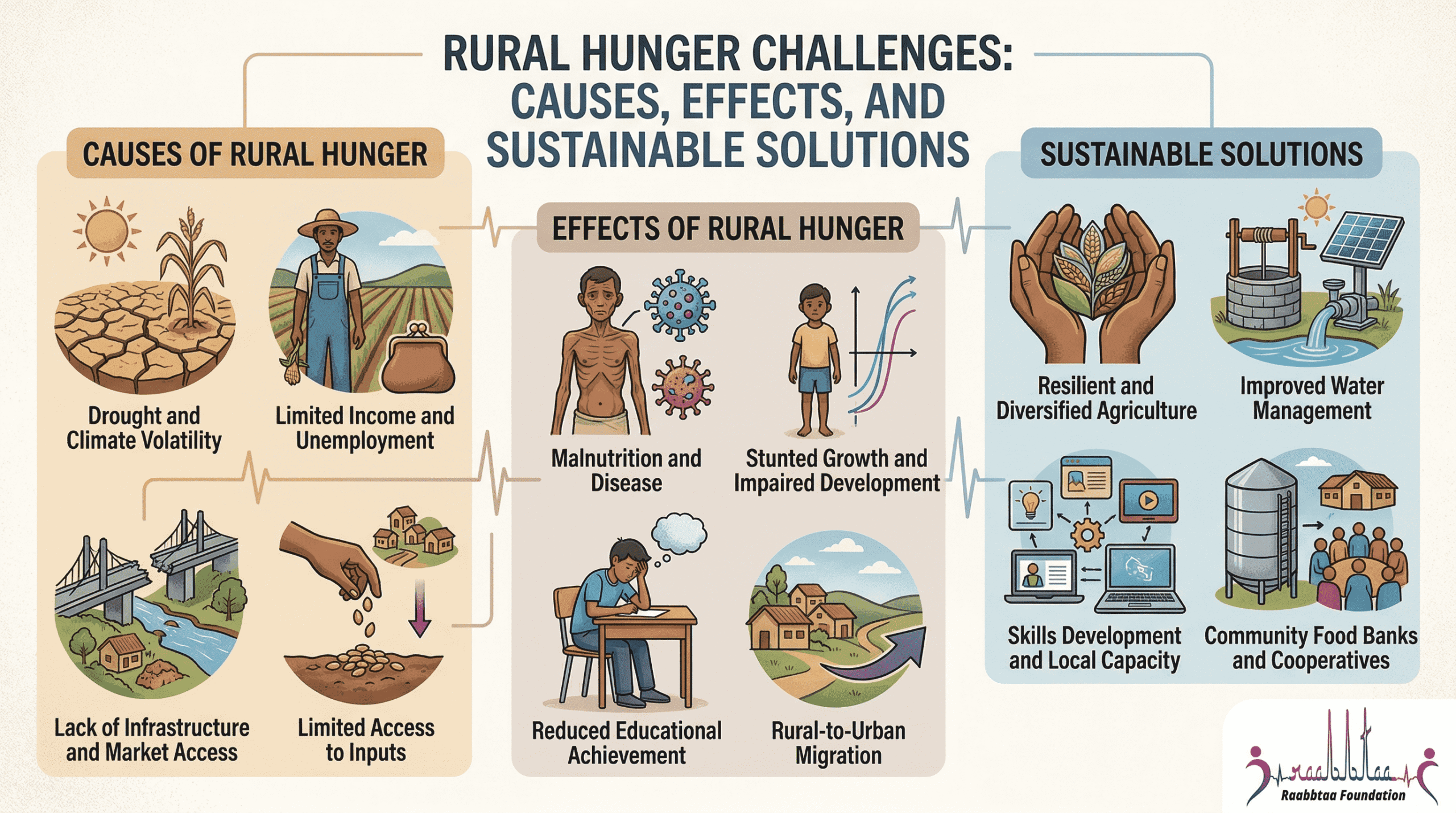
Understanding the root causes of rural hunger challenges helps stakeholders design targeted interventions. Several interconnected factors contribute to food insecurity in rural regions.
1. Poverty and Limited Income Opportunities
Poverty remains the primary driver of rural hunger challenges. Many rural households depend on seasonal agricultural work, which generates inconsistent income. During off-season periods, families may struggle to afford food.
Additionally, rural economies often lack diversified employment opportunities. Without alternative sources of income, households become vulnerable to economic shocks, such as crop failure or livestock loss.
2. Climate Change and Environmental Stress
Climate change significantly intensifies rural hunger challenges. Rising temperatures, irregular rainfall, floods, and droughts directly affect crop yields. Smallholder farmers are particularly vulnerable because they rely on natural rainfall rather than irrigation systems.
Furthermore, environmental degradation, such as soil erosion and deforestation, reduces agricultural productivity. Over time, declining soil fertility leads to lower harvests and increased food scarcity.
3. Poor Infrastructure
Infrastructure limitations are a major barrier in addressing rural hunger challenges. Many rural communities lack paved roads, storage facilities, and reliable transportation. As a result, farmers cannot easily transport crops to markets.
Post-harvest losses also increase when storage facilities are inadequate. Food spoils before reaching consumers, which reduces both food supply and farmers’ income.
4. Limited Access to Markets and Credit
Access to markets plays a crucial role in food security. However, rural farmers often face difficulties selling their produce due to distance, transportation costs, or lack of information about market prices.
Similarly, access to financial services is limited. Without credit or insurance, farmers cannot invest in improved seeds, fertilizers, or irrigation systems. This financial exclusion perpetuates rural hunger challenges across generations.
5. Social Inequality and Gender Disparities
Social structures can intensify rural hunger challenges. In many regions, women make up a large portion of the agricultural workforce but have limited access to land ownership, credit, and training. Consequently, their productivity remains constrained.
Addressing gender inequality can significantly reduce hunger because empowering women farmers improves household nutrition and agricultural output.
The Impact of Rural Hunger on Communities
Rural hunger challenges extend beyond food shortages. They affect health, education, economic development, and social stability.
First, chronic hunger weakens immune systems, making individuals more susceptible to disease. Malnutrition in children can cause stunted growth, cognitive impairment, and long-term health complications.
Second, hunger limits educational attainment. Children who lack proper nutrition often struggle to concentrate in school. Many leave school early to work and support their families, perpetuating cycles of poverty.
Third, rural hunger slows economic growth. When communities lack adequate nutrition, labor productivity declines. This reduces agricultural output and local economic activity.
Finally, persistent hunger can lead to migration. Many rural residents move to cities seeking employment and food security. However, migration can strain urban resources and create additional socioeconomic challenges.
Why Hunger Persists in Food-Producing Regions
It may seem paradoxical that hunger exists in areas where food is produced. Nevertheless, rural hunger challenges persist due to structural and systemic issues.
One reason is that farmers often sell most of their crops to generate income. After selling their produce, they may not earn enough to buy sufficient nutritious food for their families.
Another factor is price volatility. When crop prices fall, farmers’ income drops dramatically. Conversely, when food prices rise, they cannot afford to purchase food.
Land ownership patterns also play a role. Many rural farmers cultivate land they do not own, which limits their ability to invest in long-term improvements such as irrigation or soil restoration.
Global Regions Most Affected by Rural Hunger
Rural hunger challenges affect every continent, but certain regions experience higher levels of food insecurity.
Sub-Saharan Africa: Frequent droughts, limited infrastructure, and economic instability contribute to widespread hunger.
South Asia: High population density and land fragmentation reduce agricultural productivity.
Latin America: Inequality and land distribution issues exacerbate rural poverty.
Despite regional differences, the underlying causes remain similar: poverty, limited resources, and environmental vulnerability.
Sustainable Solutions to Rural Hunger Challenges
Addressing rural hunger requires comprehensive strategies that tackle both immediate needs and long-term structural issues. Effective solutions combine policy reform, technological innovation, and community participation.
1. Investing in Agricultural Innovation
Modern farming techniques can significantly reduce rural hunger challenges. Improved seeds, irrigation systems, and soil management practices increase crop yields and resilience.
For example, drought-resistant crops help farmers maintain production during dry seasons. Similarly, precision agriculture technologies enable efficient use of water and fertilizers.
2. Strengthening Rural Infrastructure
Infrastructure development is essential for improving food security. Building roads, storage facilities, and irrigation systems enhances agricultural productivity and market access.
Better infrastructure also reduces post-harvest losses. When farmers can store crops safely, they can sell them later at better prices, increasing household income.
3. Expanding Access to Financial Services
Financial inclusion plays a vital role in overcoming rural hunger challenges. Access to microcredit, insurance, and savings programs enables farmers to invest in their farms and manage risks.
For instance, crop insurance protects farmers against losses caused by extreme weather. This financial safety net encourages investment in productivity-enhancing technologies.
4. Supporting Education and Training
Education empowers rural communities to improve food security. Agricultural training programs teach farmers modern techniques, resource management, and climate adaptation strategies.
Nutrition education is equally important. When families understand balanced diets, they make better food choices even with limited resources.
5. Promoting Gender Equality
Empowering women is one of the most effective ways to address rural hunger challenges. Studies consistently show that when women have equal access to resources, agricultural productivity increases.
Policies that support women’s land rights, financial access, and education can transform rural economies and improve household nutrition.
6. Strengthening Social Protection Programs
Social safety nets help vulnerable populations cope with food shortages. Programs such as food subsidies, school feeding initiatives, and cash transfers provide immediate relief while long-term solutions take effect.
These programs also stabilize local economies by increasing purchasing power and supporting small farmers.
The Role of Governments and Organizations
Governments, NGOs, and international organizations play a central role in addressing rural hunger challenges. Policy frameworks that prioritize rural development can transform food systems.
Governments can implement agricultural subsidies, invest in infrastructure, and support research initiatives. Meanwhile, nonprofit organizations often provide training, resources, and emergency food assistance.
Collaboration among stakeholders is essential. When governments, private companies, and communities work together, solutions become more sustainable and scalable.
How Technology Is Transforming Rural Food Security
Technology is rapidly changing how rural communities address hunger. Digital tools provide farmers with weather forecasts, market prices, and farming advice via mobile phones.
Additionally, satellite data helps monitor crop health and predict yields. These innovations allow farmers to make informed decisions and reduce losses.
E-commerce platforms also connect rural farmers directly with buyers. By eliminating intermediaries, farmers receive fairer prices and improve their livelihoods.
Community-Driven Approaches to Ending Hunger
Local participation is crucial for solving rural hunger challenges. Community-based initiatives often succeed because they reflect local needs and cultural practices.
Examples include cooperative farming, shared storage facilities, and community gardens. These initiatives strengthen social networks and improve food distribution.
Furthermore, local leadership ensures accountability and sustainability. When communities take ownership of solutions, projects are more likely to succeed in the long term.
Future Outlook for Rural Hunger Reduction
The future of global food security depends largely on how effectively rural hunger challenges are addressed. Population growth, climate change, and economic inequality will continue to pressure food systems.
However, progress is possible. Advances in agricultural science, renewable energy, and digital technology offer new opportunities to improve rural livelihoods. With strategic investment and coordinated action, hunger can be reduced significantly.
International commitments to sustainable development also provide a framework for action. By prioritizing rural communities, policymakers can ensure that progress reaches those most affected by food insecurity.
Conclusion
Rural hunger challenges remain a complex global issue, but they are not insurmountable. The causes—poverty, climate change, poor infrastructure, and inequality—are interconnected, which means solutions must be equally comprehensive.
By investing in agriculture, improving infrastructure, expanding financial access, and empowering communities, societies can create resilient food systems. Moreover, collaboration among governments, organizations, and local communities is essential for lasting change.
Addressing rural hunger challenges is not only a humanitarian priority but also an economic and environmental necessity. When rural populations have reliable access to nutritious food, they can thrive, contribute to development, and build sustainable futures.