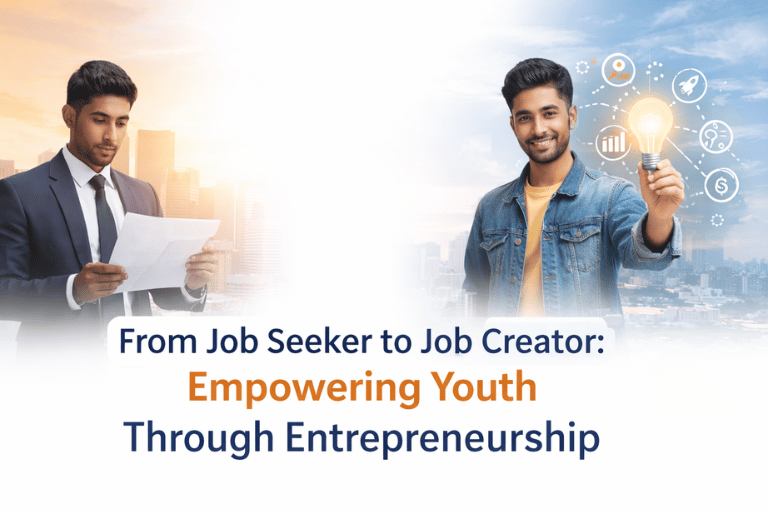
From Job Seeker to Job Creator: Empowering Youth Through Entrepreneurship
In today’s fast-changing economy, traditional career paths are no longer guaranteed. As a result, young people across the world are facing rising unemployment, skill mismatches, and limited job opportunities. However, instead of waiting for jobs to appear, many youths are choosing to create their own. Youth entrepreneurship empowerment has emerged as a powerful solution that transforms job seekers into job creators.
Moreover, entrepreneurship does more than generate income. It builds confidence, encourages innovation, and strengthens communities. Therefore, empowering young people to start and grow businesses is not just an economic strategy—it is a social investment in the future.
The Shift from Job Seeker to Job Creator
Traditionally, education systems have prepared students to seek employment rather than create it. Consequently, many graduates enter the workforce expecting stable jobs that are increasingly scarce. However, this mindset is rapidly changing.
Today, young people are learning to see problems as opportunities. Instead of asking “Who will hire me?”, they are asking “What solution can I build?”. As a result, the transition from job seeker to job creator is becoming more achievable than ever before.
Furthermore, digital tools, remote work, and global markets have lowered the barriers to entry. Therefore, entrepreneurship is no longer limited to those with large capital or elite connections.
Why Youth Entrepreneurship Matters More Than Ever
Youth entrepreneurship is not a trend—it is a necessity. In fact, economies with strong entrepreneurial ecosystems tend to grow faster and adapt better to change. When young people create businesses, they also create employment for others.
Additionally, youth-led startups often bring fresh ideas to traditional industries. As a result, innovation accelerates across sectors such as technology, education, agriculture, and healthcare.
Most importantly, entrepreneurship empowers youth to take control of their economic future. Therefore, it reduces dependency on limited job markets while increasing self-reliance.
Key Benefits of Empowering Young Entrepreneurs
Economic Growth and Job Creation
When youth start businesses, they do more than support themselves. Over time, they employ peers, mentors, and community members. Consequently, entrepreneurship becomes a multiplier of economic opportunity.
Moreover, small and medium enterprises contribute significantly to GDP in many countries. Therefore, supporting youth entrepreneurship directly strengthens national economies.
Innovation and Problem Solving
Young entrepreneurs are uniquely positioned to solve modern problems. Because they grow up with technology, they often understand digital solutions better than older generations.
For example, many youth-led startups focus on sustainability, fintech, or social impact. As a result, entrepreneurship becomes a tool for solving real-world challenges.
Personal Growth and Leadership Development
Entrepreneurship builds resilience, creativity, and leadership. While failure is part of the journey, each setback strengthens problem-solving skills.
Consequently, young entrepreneurs develop confidence that benefits them in all areas of life. Even if a business fails, the experience remains invaluable.
Challenges Faced by Young Entrepreneurs
Despite its potential, youth entrepreneurship is not without obstacles. Therefore, understanding these challenges is essential for meaningful empowerment.
Limited Access to Funding
Many young people struggle to secure startup capital. Since they often lack credit history or collateral, traditional financing becomes difficult.
However, microfinance, grants, and angel investors are slowly filling this gap. As a result, alternative funding models are becoming more accessible.
[H3] Lack of Mentorship and Guidance
Without experienced mentors, young entrepreneurs may struggle to scale their ideas. Consequently, many promising businesses fail prematurely.
That said, incubators and accelerators are increasingly offering structured support. Therefore, mentorship is becoming more available than before.
Fear of Failure and Social Pressure
In many cultures, failure is discouraged. As a result, young people hesitate to take entrepreneurial risks.
However, promoting a growth mindset can change this narrative. When failure is seen as learning, confidence grows naturally.
The Role of Education in Youth Entrepreneurship Empowerment
Education plays a critical role in shaping entrepreneurial mindsets. Instead of focusing only on exams, schools must teach creativity, financial literacy, and problem-solving.
Moreover, entrepreneurship education should begin early. When students learn business fundamentals young, they develop confidence faster.
Additionally, practical learning—such as internships and startup simulations—helps bridge theory and reality. Therefore, education systems must evolve to meet modern needs.
Technology as a Catalyst for Young Entrepreneurs
Technology has revolutionized entrepreneurship. Today, a young person with a smartphone can run a global business.
For instance, social media enables low-cost marketing. Similarly, e-commerce platforms remove the need for physical stores. As a result, startups can scale faster than ever.
Furthermore, online learning platforms provide free access to business knowledge. Therefore, lack of formal education is no longer a barrier.
Government and Policy Support for Youth Entrepreneurs
Governments play a vital role in creating supportive ecosystems. Through favorable policies, they can encourage youth entrepreneurship at scale.
For example, tax incentives, startup grants, and simplified registration processes reduce entry barriers. Consequently, more young people are willing to start businesses.
Additionally, public-private partnerships strengthen entrepreneurial infrastructure. Therefore, collaboration becomes key to long-term success.
Practical Steps to Empower Youth Through Entrepreneurship
Encourage an Entrepreneurial Mindset
Empowerment begins with mindset. Young people must believe that they can create value.
Therefore, storytelling, role models, and success stories are powerful motivators.
Provide Skills-Based Training
Entrepreneurs need more than ideas. They need skills in marketing, finance, and operations.
As a result, hands-on training programs are far more effective than theory alone.
Improve Access to Capital
Affordable financing enables youth to turn ideas into reality. Hence, youth-focused funding programs are essential.
Build Strong Support Networks
Communities, mentors, and peer groups create accountability. Consequently, entrepreneurs are more likely to succeed.
Real-World Impact: Youth Entrepreneurs Changing Lives
Across the globe, young entrepreneurs are transforming industries. From agribusiness startups to tech platforms, their impact is undeniable.
Moreover, many youth-led ventures focus on social problems. As a result, entrepreneurship becomes a force for inclusive growth.
These success stories prove that with the right support, young people can lead economic transformation.
The Future of Work Belongs to Job Creators
The future of work is uncertain. Automation, AI, and globalization are reshaping employment rapidly.
However, entrepreneurship provides adaptability. Instead of depending on one employer, young people create multiple income streams.
Therefore, empowering youth to become job creators is the most sustainable response to future uncertainty.
Why Coverage Is a Long-Term Investment
Health insurance is not just an expense. It is an investment in stability.
Coverage protects against:
Unexpected surgeries
Chronic disease management costs
Prescription medication expenses
Long-term hospital stays
Over time, insured families experience fewer financial disruptions.
Additionally, consistent healthcare access improves life expectancy and quality of life.
Conclusion: Investing in Youth Entrepreneurship Is Investing in the Future
Empowering youth through entrepreneurship transforms challenges into opportunities. By shifting from job seekers to job creators, young people gain control over their futures.
Moreover, societies benefit from innovation, employment, and economic resilience. Therefore, investing in youth entrepreneurship is not optional—it is essential.
With the right education, technology, and support, the next generation of entrepreneurs will shape a stronger, more inclusive world.